Research News

Introducing the latest research achievements and published papers from CGER

MNRAS2025

Revised Supernova Analysis Shows Perfect Agreement with BAO and CMB Results

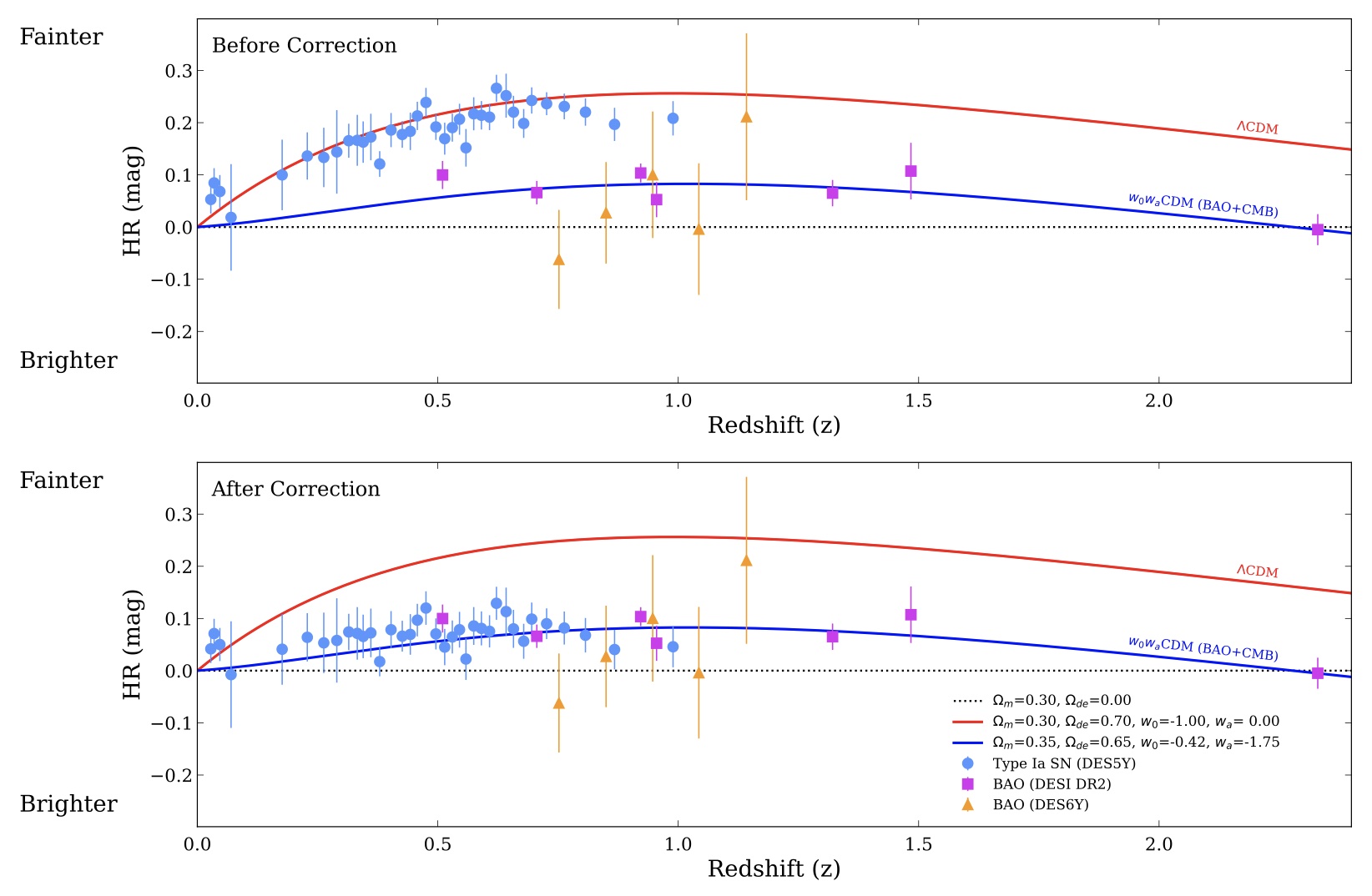
Researchers at the Center for Galaxy Evolution Research have published a key result directly challenging the conventional theory of cosmic acceleration, particularly the assumption that dark energy is a cosmological constant. The team found that newly revised supernova observations agree far more precisely with baryon acoustic oscillation measurements.

A joint analysis of supernova, BAO, and cosmic microwave background data further suggests a surprising result: the universe is no longer accelerating but has entered a decelerating phase. If confirmed through further verification, this finding could mark a turning point in our understanding of dark energy, the Hubble tension, and the expansion history and ultimate fate of the universe.

View Paper: Son, Lee et al. (2025, MNRAS) →
MNRAS2025

Revised Supernova Analysis Shows Perfect Agreement with BAO and CMB Results

Researchers at the Center for Galaxy Evolution Research have published a key result directly challenging the conventional theory of cosmic acceleration, particularly the assumption that dark energy is a cosmological constant. The team found that newly revised supernova observations agree far more precisely with baryon acoustic oscillation measurements.

A joint analysis of supernova, BAO, and cosmic microwave background data further suggests that the universe is no longer accelerating but has entered a decelerating phase. If confirmed, this result could reshape our understanding of dark energy, the Hubble tension, and the expansion history and ultimate fate of the universe.

View Paper: Son, Lee et al. (2025, MNRAS) →
A&A2026

High-Resolution Galaxy Cluster Simulation “NewCluster” Successfully Completed

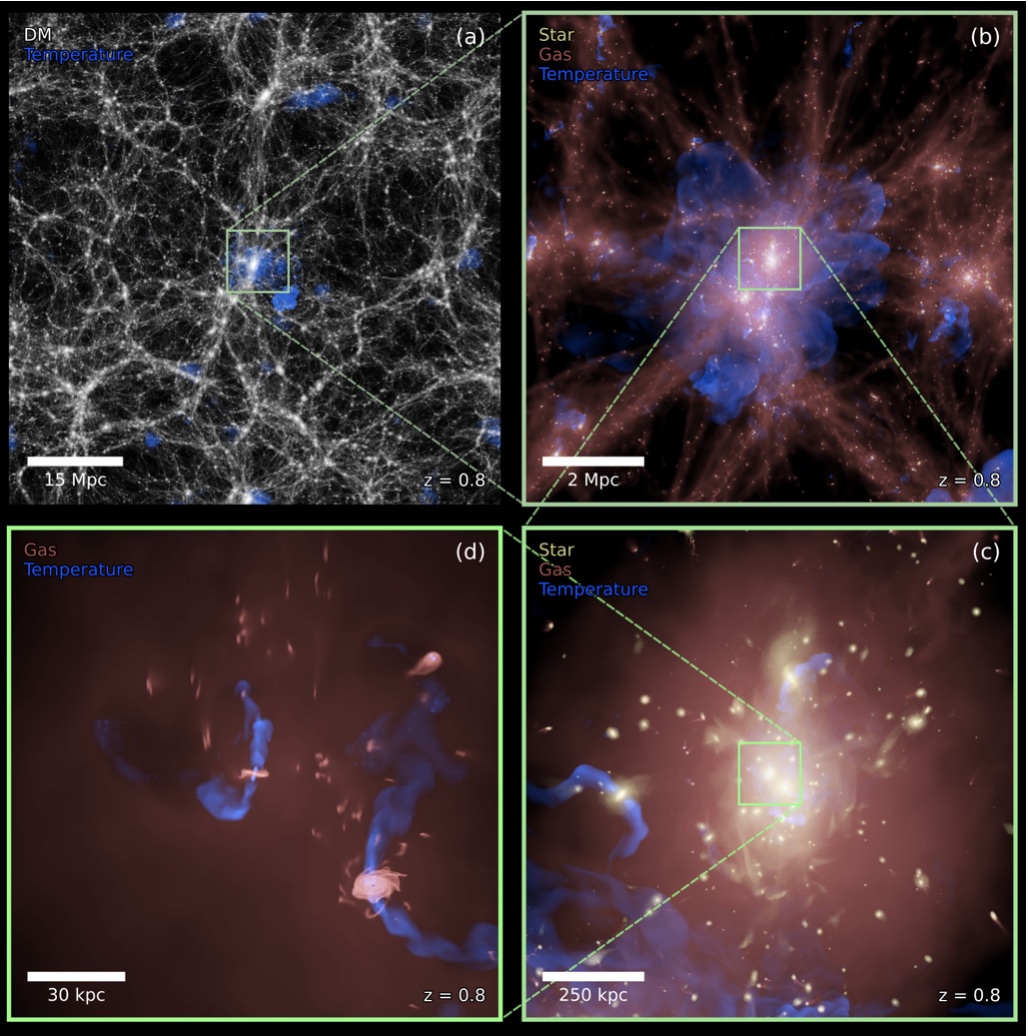
The research team successfully carried out the cutting-edge high-resolution galaxy cluster simulation NewCluster, demonstrating strong international competitiveness in computational astrophysics.

After three years of numerical computation, the evolution of a galaxy cluster was simulated down to z≈0.8. Clear environmental effects such as ram-pressure stripping, jellyfish galaxies, and early environmental quenching were already evident. NewCluster is regarded as a leading international achievement in terms of resolution, physical completeness, and numerical methodology.

View Paper: Han, Yi et al. (2026, A&A) →
A&A2025

Successful Cosmological Radiation-Hydrodynamic Simulation with a Bursty Star Formation Model

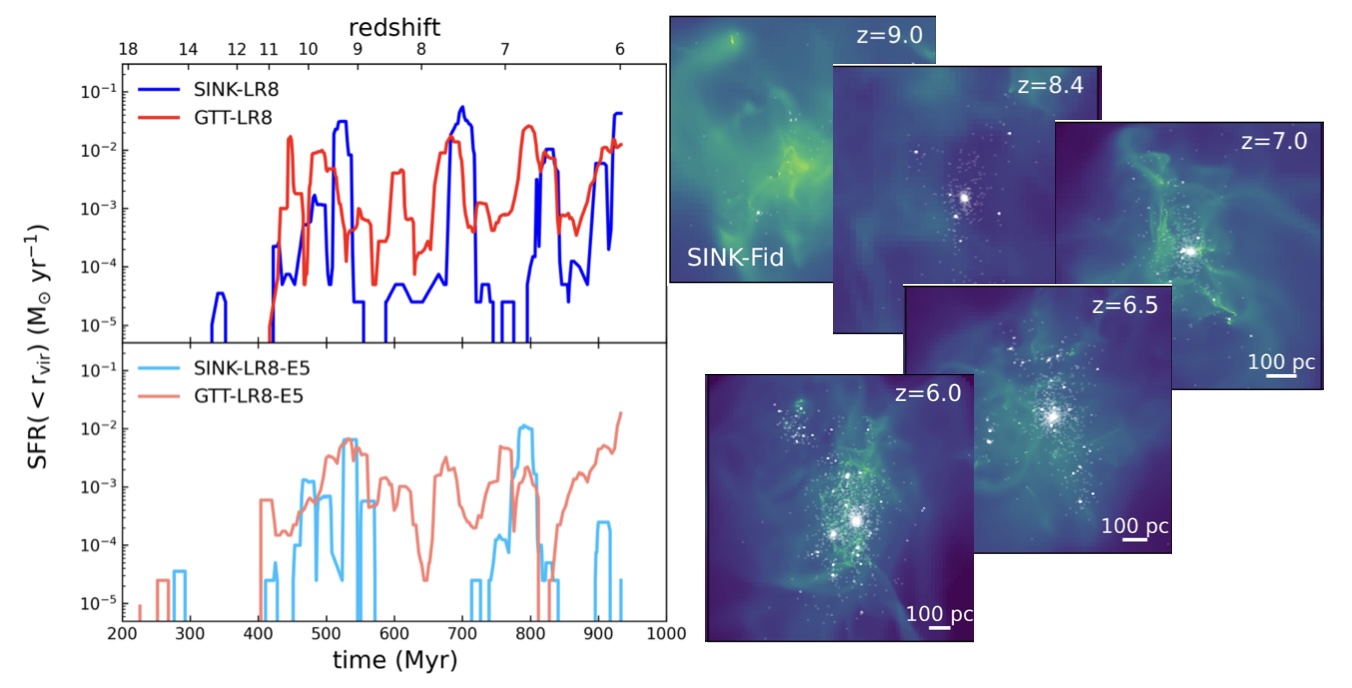
In collaboration with researchers at Oxford (UK) and Chicago/Princeton (USA), our team successfully performed a cosmological radiation-hydrodynamic simulation using a newly developed precision star formation model.

Moving beyond traditional models that estimate star formation rates from local conditions, the new approach directly calculates gas inflow and implements star formation accordingly. The results demonstrate that star formation can proceed in highly bursty and explosive episodes.

View Paper: Kang, Cheonsu et al. (2024, A&A) →
ApJS2024

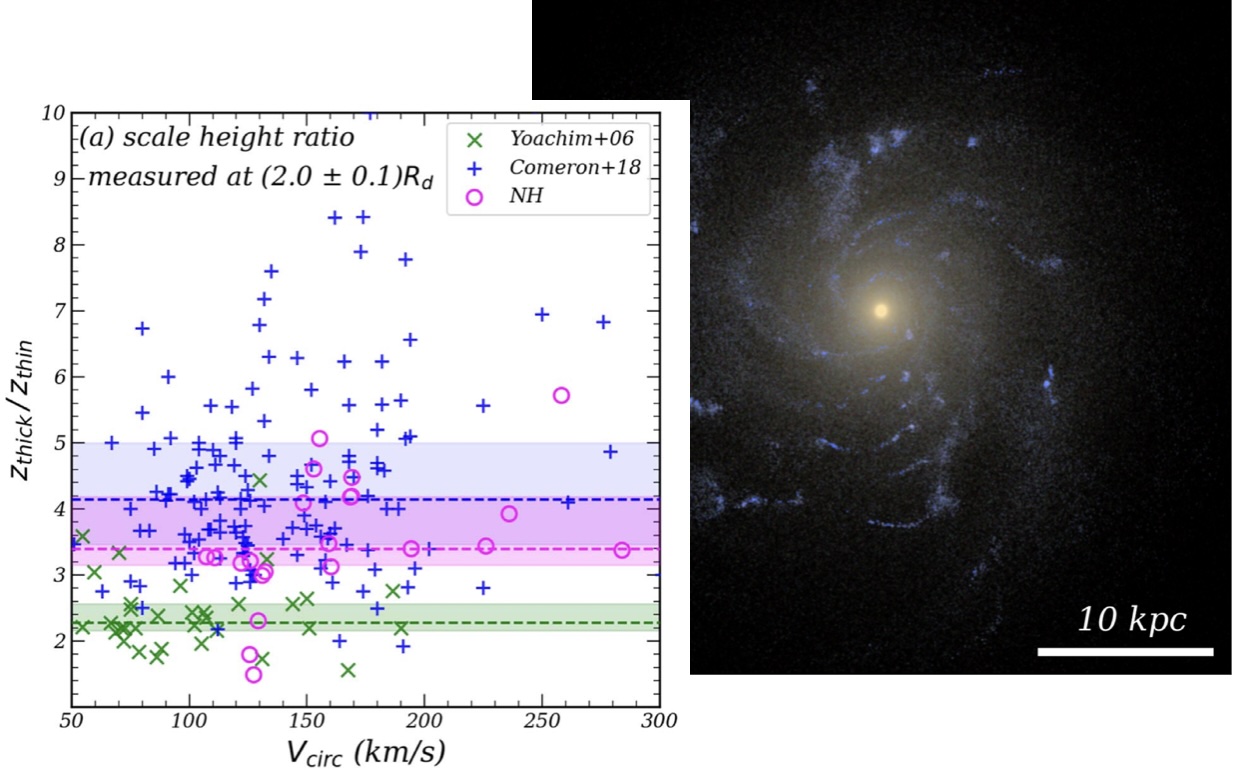
Formation Mechanism of the Thick Disk in Spiral Galaxies Revealed

In collaboration with IAP (France) and Oxford (UK), the team carried out the NewHorizon2 simulation and uncovered the formation mechanism of the thick disk, a key structural component of spiral galaxies.

The NewHorizon2 experiment, led by our center, tracked multiple chemical elements to model chemical evolution. The results show differences between chemically defined thick disks and those defined by luminosity, and demonstrate that galaxy mergers and star formation histories can drive distinct chemical evolution pathways.

View Paper: Yi, Sukyoung et al. (2024, ApJS) →
ApJ2023

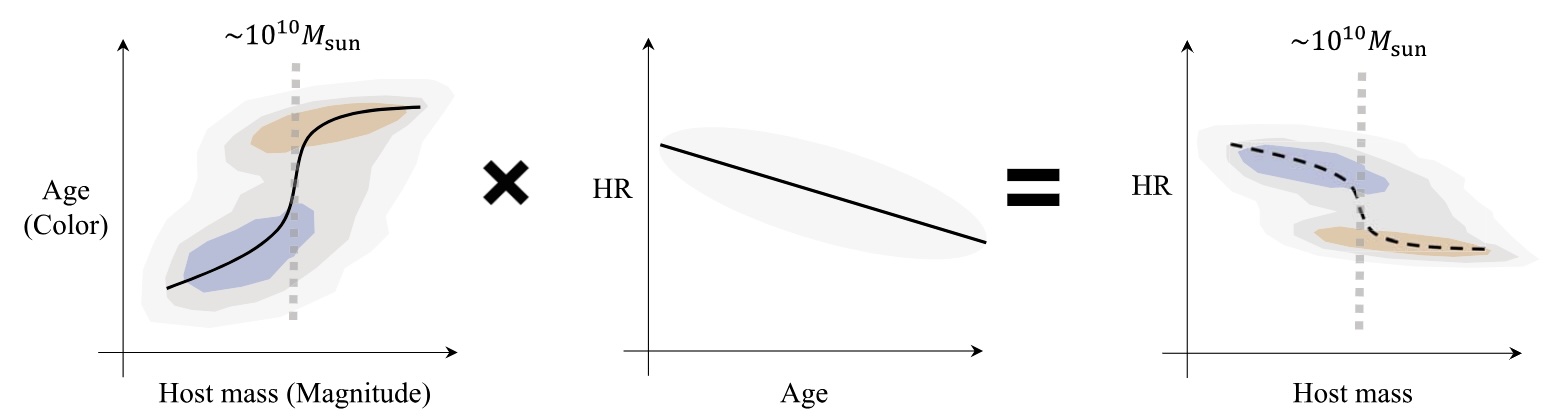
Fundamental Origin of the Correlation Between Type Ia Supernovae and Host Galaxy Mass Identified

The team discovered that the empirical mass-step correction applied in Type Ia supernova luminosity standardization arises from the age of the host galaxy.

Using SDSS galaxy observations representative of Type Ia supernova host populations, the study found a nonlinear relationship between galaxy mass and age, revealing a bimodal age distribution among host galaxies.

View Paper: Chung, Chul et al. (2023, MNRAS) →
MNRAS2023

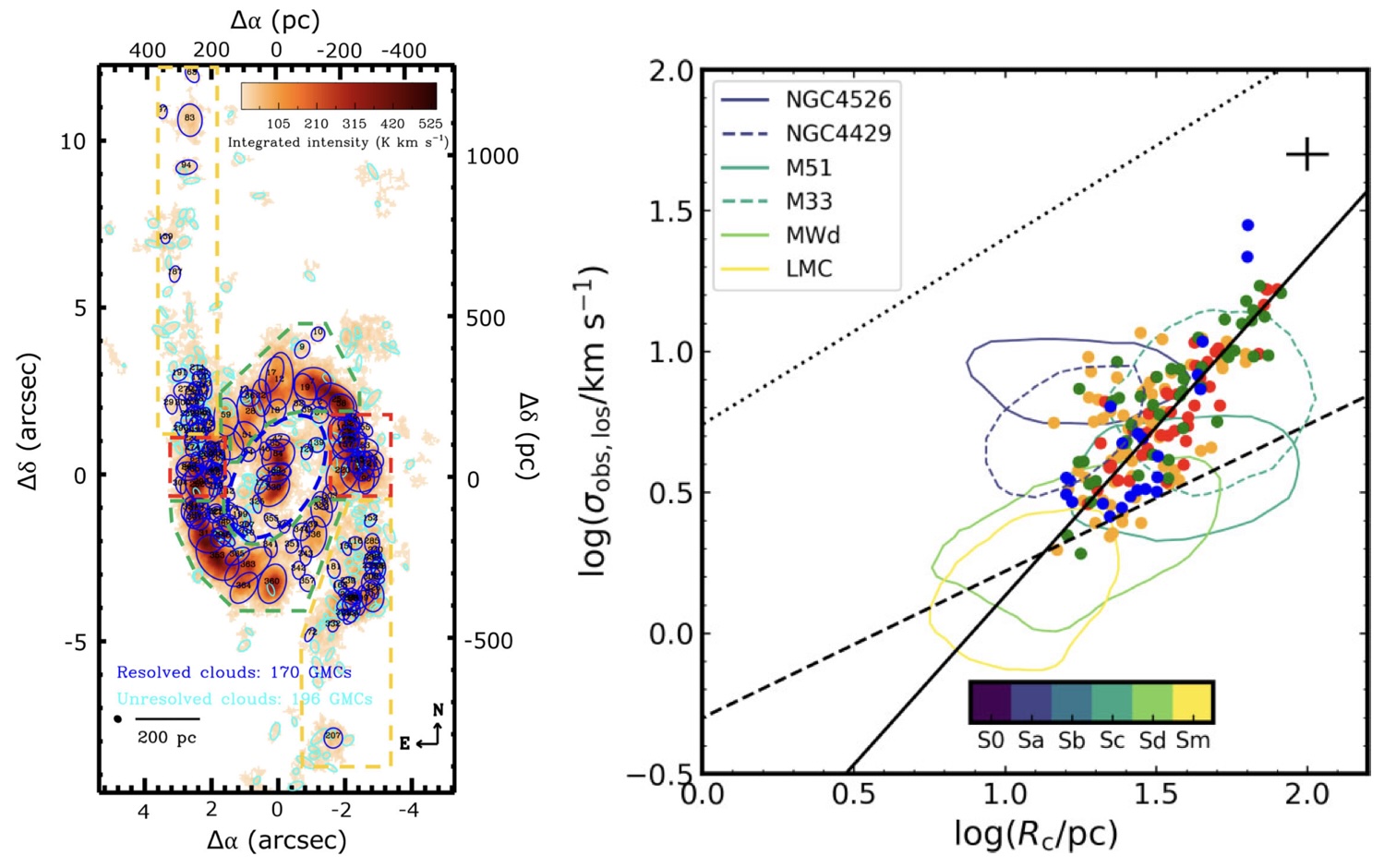
New Properties of Giant Molecular Clouds Revealed Based on Galactic Structure

Giant molecular clouds are star-forming gas complexes and a fundamental component of galaxy evolution theory. Using high-resolution ALMA data and robust analysis techniques, the team demonstrated for the first time that GMCs in barred spiral galaxies exhibit dynamical properties distinct from those in typical spiral environments.

View Paper: Choi, Woorak et al. (2023, MNRAS) →
MNRAS2022

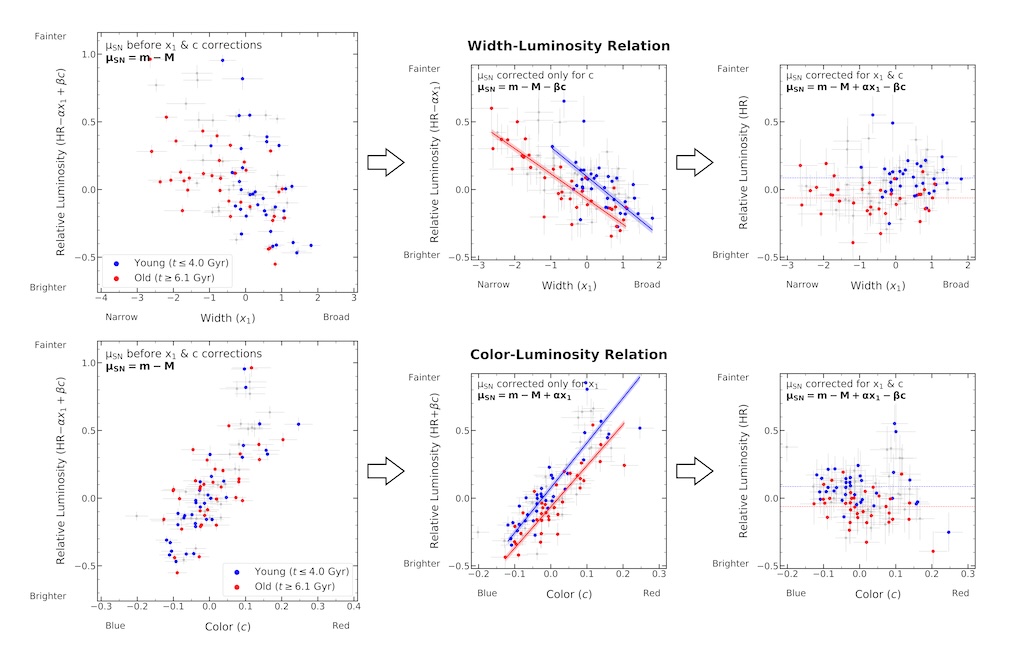
Smoking-Gun Evidence Challenging the Nobel-Prize-Winning Cosmic Acceleration Paradigm

From a recent study on the luminosity standardization of Type Ia supernovae, our team uncovered evidence suggesting that the cosmic acceleration paradigm, awarded the 2011 Nobel Prize in Physics, may require fundamental revision.

Younger progenitor systems produce dimmer standardized luminosities, with a magnitude of effect significant enough to demand substantial modification of the current cosmological framework.

View Paper: Lee, Young-Wook et al. (2022, MNRAS) →